
In the money world, nothing remains constant.
Markets change, technology evolves, regulations shift, and customer expectations rise.
However, Ben Sadgrove notes that trust remains vital through all these changes.
Successfully developing new services or entering into new areas is no longer the sole criterion for success for financial organizations operating internationally. It also requires operational resilience, communication, responsible decision making and trust that they engender with their clients.
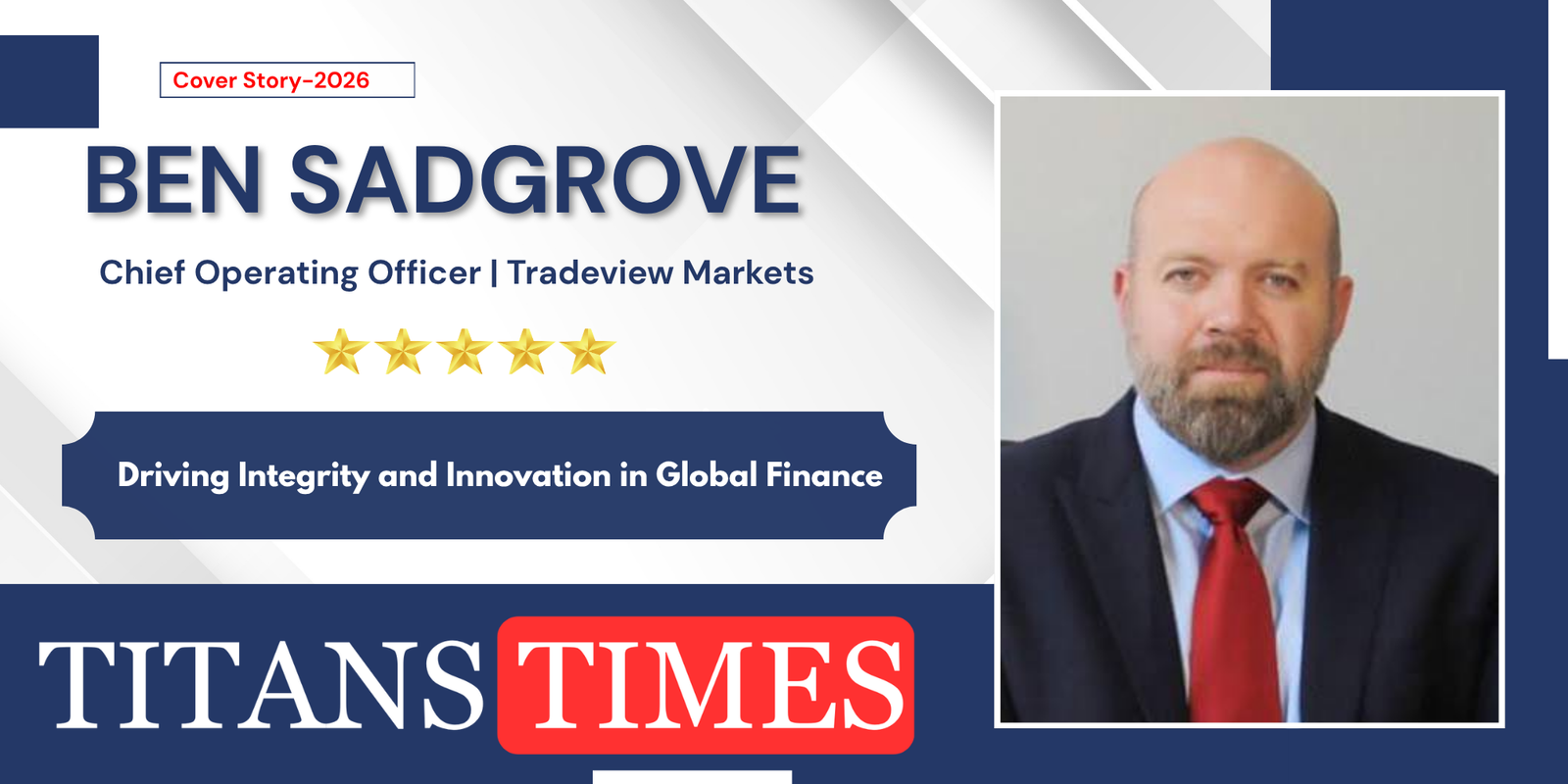
The cover story of Titans Times Magazine for 2026 features the themes prominently.
Moreover, it includes Ben Sadgrove, who appears on the cover as Chief Operating Officer of Tradeview Markets.
In the editorial feature “Driving Integrity and Innovation in Global Finance”, the article explores essential leadership traits.
Moreover, Ben Sadgrove discusses the evolving role of executives in an industry that’s constantly progressing.
Ben Sadgrove and the Importance of Operational Leadership
Behind every financial service is a network of systems, processes, people, and decisions that customers rarely see.
A trading platform may appear straightforward from the outside. A client logs in, accesses market information, and interacts with a digital interface. Behind that experience, however, are numerous operational considerations involving technology, service delivery, risk controls, security, and coordination.
This is why the role of a Chief Operating Officer is so important.
While corporate strategy establishes where an organization wants to go, operational leadership helps determine how it gets there.
A COO must typically connect the organization’s broader objectives with its everyday activities. That may involve improving internal processes, strengthening communication between departments, evaluating operational risks, and ensuring that business priorities translate into practical execution.
For a financial services organization, these responsibilities can become particularly complex.
Market activity takes place across time zones. Technology must support demanding workloads. Customers expect timely communication, while internal teams must work within applicable regulatory and operational requirements.
Effective leadership requires an understanding of how these elements interact.
Ben Sadgrove’s appearance on the Titans Times cover provides an opportunity to examine this often-underappreciated dimension of executive leadership: the ability to make complex organizations work more consistently, responsibly, and effectively.
Featured Executive at a Glance
| Profile | Details |
| Featured leader | Ben Sadgrove |
| Designation on cover | Chief Operating Officer |
| Organization | Tradeview Markets |
| Industry | Financial services and trading |
| Magazine | Titans Times |
| Cover story theme | Driving Integrity and Innovation in Global Finance |
| Edition | 2026 |
Why Integrity Remains the Foundation of Financial Services
Confidence is a critical aspect of financial services.
Financial institutions’ communication, data protection, risk disclosure, and responsibilities are important to the customers.
Financial services are often decisions that have implications that will likely not be evident in the short term, unlike many other consumer decisions.
The need for clarity and good behavior is particularly evident in that context.
Financial integrity is not just a company’s values. It should be seen in the processes and decisions that are used in affecting the customer experience.
For instance, transparency in communication enables customers to better grasp the nature of financial products, associated costs, limitations of services, and risks.
Implementing consistent internal controls can assist companies to pinpoint operational shortcomings before they grow into more significant issues.
Accountability also matters.
In times of difficulties, businesses require clear-cut responsibilities, proper escalating processes and a resolution focus on solving issues instead of covering them up.
These principles are especially applicable to the online trading sector, where customers could come across intricate products, volatility, and fast varying monetary conditions.
Reliable leadership is not enough to eradicate uncertainty in the financial markets. Instead, it sets up an organizational setting where responsibilities are clear and decisions are taken appropriately.
Innovation That Serves a Real Purpose
Innovation has become an essential part of modern financial services.
Digital platforms, automation, cloud infrastructure, and advanced data analysis have transformed how organizations operate and interact with customers.
However, technology is valuable only when it solves meaningful problems.
A faster process may improve efficiency, but only if it remains reliable. An automated workflow may reduce repetitive work, but it still requires appropriate oversight. A redesigned customer platform may improve accessibility, but it must also be understandable and secure.
The most effective financial innovation combines technological capability with a clear understanding of customer needs.
For operational leaders, this means asking practical questions before adopting new solutions.
Will the technology improve service delivery? Can employees use it effectively? Are the risks understood? Does it support the organization’s long-term objectives?
These questions help distinguish purposeful innovation from change pursued merely because a technology is fashionable.
As financial organizations continue to modernize, the relationship between technology and operational discipline will remain central to sustainable progress.
Connecting Global Strategy with Everyday Execution
Global financial services operate within an interconnected environment.
Customer expectations, technology infrastructure, regulatory obligations, and commercial conditions may differ significantly across markets.
A process that works effectively in one region may require adjustments elsewhere.
Organizations must therefore balance the benefits of standardization with the need to understand local requirements.
This creates an important challenge for operational leadership.
Consistency supports efficiency, but flexibility allows organizations to respond to different circumstances.
The goal is not to make every market identical. It is to establish dependable standards while recognizing where legitimate differences require a tailored approach.
Communication plays an important role in achieving this balance.
Teams must understand organizational priorities and know when issues require escalation or collaboration across departments.
Strong operational structures can help prevent confusion, duplicated effort, and unnecessary delays.
In this sense, operational excellence is not simply about doing things faster.
It is about ensuring that the right work is completed by the right people, using appropriate information and processes.
The Human Side of Financial Leadership
Technology is often at the center of conversations about the future of finance.
Yet behind every platform, system, and customer interaction are people.
Employees interpret information, resolve problems, develop products, maintain infrastructure, and support customers.
Even highly automated organizations depend on human judgment.
This makes workplace culture an important part of operational performance.
When employees understand their responsibilities and feel comfortable raising concerns, organizations can identify challenges earlier.
A culture of collaboration also makes it easier for teams to share knowledge and improve processes.
Leadership has an important role in establishing these conditions.
Clear expectations reduce uncertainty. Constructive feedback supports improvement. Professional development helps employees adapt as technology and business requirements change.
Equally important is the willingness to listen.
Frontline employees often encounter recurring problems before senior management becomes aware of them.
Organizations that value these observations may be better positioned to identify opportunities for improvement.
For executives working in complex financial environments, people-focused leadership is not separate from business performance. It is one of the factors that supports it.
Risk Management in an Unpredictable Market
Financial markets are influenced by economic developments, geopolitical events, investor expectations, and changing liquidity conditions.
These factors can create uncertainty for market participants and the organizations serving them.
Operational risk management is therefore a continuing responsibility.
Financial businesses must consider potential disruptions involving technology, information security, third-party providers, business continuity, and internal processes.
The precise requirements vary according to the organization’s activities and applicable jurisdictions.
Effective risk management begins with recognizing that not every risk can be eliminated.
Instead, organizations need to understand their exposures, establish proportionate controls, and prepare appropriate responses.
This may involve maintaining reliable records, defining decision-making authority, testing continuity arrangements, and reviewing processes as circumstances change.
Risk management should also evolve alongside innovation.
Introducing new technology or expanding into additional markets can create opportunities, but it may also introduce unfamiliar dependencies.
Responsible operational leadership considers both sides of that equation.
Key Priorities in Modern Financial Operations
| Operational priority | Why it matters |
| Transparency | Helps customers and stakeholders understand important information |
| Technology reliability | Supports consistent access to digital services |
| Risk management | Helps identify and manage operational vulnerabilities |
| Regulatory compliance | Supports adherence to applicable rules and obligations |
| Customer communication | Builds understanding and confidence |
| Employee development | Strengthens organizational capability and adaptability |
| Business continuity | Helps organizations prepare for unexpected disruptions |
Digital Transformation and the Future of Trading Services
The development of online financial platforms has changed how customers access market information and trading services.
Digital tools have made many processes more convenient, while also increasing expectations around reliability, responsiveness, and accessibility.
For financial services organizations, digital transformation now extends beyond creating an attractive interface.
It includes the underlying systems that support account administration, customer communication, transaction processing, monitoring, and operational reporting.
As these systems become more interconnected, organizations must consider how changes in one area affect the wider business.
A new customer-facing feature may depend on several internal services. An automated process may require new oversight arrangements. A technology upgrade may affect employee workflows or customer support.
These relationships make operational planning essential.
Successful digital transformation requires collaboration between technology specialists, compliance professionals, operational teams, and business leadership.
It also requires realistic expectations.
Not every improvement needs to be revolutionary. Sometimes a simpler process, clearer communication, or more reliable system can create significant practical value.
Artificial Intelligence and Responsible Innovation
Artificial intelligence is introducing new possibilities across financial services.
Organizations are exploring how AI-assisted systems can support information analysis, administrative processes, customer interactions, and operational monitoring.
These applications may improve efficiency, but they also introduce important questions.
How is information protected? Can automated outputs be verified? Who is accountable when a system produces an incorrect result? What happens when a process requires human intervention?
Such questions demonstrate why technological innovation must be accompanied by governance.
Organizations should understand how AI tools are being used, what information they process, and where human review remains necessary.
Data quality is another important consideration.
Automated systems depend on the information available to them. Inaccurate, incomplete, or outdated data can undermine otherwise sophisticated technology.
The future of AI in finance will therefore depend not only on technical capability but also on responsible implementation.
Organizations that combine experimentation with appropriate safeguards may be better positioned to benefit from emerging technologies without overlooking their limitations.
Building a Culture of Accountability
Accountability is often discussed as a leadership principle, but its practical meaning extends into everyday organizational activity.
Employees need to understand who is responsible for decisions, how issues should be reported, and what standards apply to their work.
Without this clarity, even well-designed processes can become ineffective.
A strong accountability culture does not require employees to operate in fear of mistakes.
Instead, it encourages ownership, constructive communication, and continuous improvement.
When problems arise, organizations benefit from understanding their causes rather than focusing only on immediate symptoms.
Was the process unclear? Was information missing? Did a system fail? Were responsibilities misunderstood?
Answering these questions can help prevent similar issues from recurring.
For financial organizations, accountability also supports consistent service delivery and responsible management of operational risk.
The strongest systems are not necessarily those that never encounter problems, but those capable of identifying, addressing, and learning from them.
Leadership in a Borderless Financial Economy
Global finance increasingly connects individuals, businesses, and institutions across geographical boundaries.
Digital platforms have expanded access to financial information and services, while international business activity has created new expectations for speed and convenience.
Yet greater connectivity also brings complexity.
Financial organizations must understand the jurisdictions in which they operate and the requirements applicable to their activities.
They must also consider differences in customer expectations, communication practices, and operational infrastructure.
This environment places a premium on adaptable leadership.
Long-term objectives provide direction, but organizations must remain prepared to adjust their strategies when market conditions, regulations, or technologies change.
Adaptability does not mean abandoning established principles.
Instead, it means applying those principles thoughtfully in new circumstances.
Integrity, accountability, and customer focus remain relevant even as the tools used to deliver financial services evolve.
What the Next Generation of Financial Leaders Must Understand
The coming years will place new demands on financial services executives.
Technological literacy will become increasingly important, but it will not replace the need for commercial judgment, ethical awareness, and effective communication.
Leaders will need to understand how digital systems affect operational performance while recognizing the importance of customer relationships and employee capabilities.
They must also distinguish between short-term trends and developments capable of creating lasting value.
Continuous learning will be essential.
As regulations, technologies, and market structures evolve, organizations must update their knowledge and reconsider established processes.
Future-ready leadership will also require humility.
No executive can anticipate every market development or technological challenge.
The ability to seek informed perspectives, acknowledge uncertainty, and adjust decisions when new evidence emerges is a strength rather than a weakness.
These qualities will help shape the next generation of responsible financial leadership.
Financial Leadership: Today and Tomorrow
| Leadership dimension | Traditional emphasis | Emerging emphasis |
| Business operations | Process efficiency | Resilience, adaptability, and integrated operations |
| Technology | System availability | Responsible automation and intelligent workflows |
| Customer relationships | Service delivery | Transparency, accessibility, and digital trust |
| Risk management | Established controls | Continuous assessment of evolving risks |
| Workforce | Functional expertise | Cross-functional collaboration and continuous learning |
| Growth strategy | Market expansion | Sustainable, risk-aware international development |
Looking Ahead: Integrity as a Long-Term Competitive Strength
The future of global finance will be shaped by the relationship between technology, regulation, customer expectations, and organizational capability.
Businesses will continue seeking ways to improve efficiency, expand access to services, and respond to changing market conditions.
However, the pursuit of innovation must remain connected to the responsibilities that accompany financial services.
Trust cannot be automated.
Technology can support better processes, but it cannot replace organizational accountability or the need for clear and responsible decisions.
This is why integrity remains relevant even as financial systems become more sophisticated.
Organizations that invest in reliable operations, transparent communication, and capable teams can establish stronger foundations for long-term progress.
For operational executives, the challenge is to bring these priorities together in ways that serve both the business and its customers.
Also read Latest News :Brendan Foody: The Young Entrepreneur Transforming AI Hiring Through Mercor
A Closing Perspective: Driving Integrity and Innovation in Global Finance
The best business changes aren’t just about technology.
They are the product of strategic direction, operational discipline, responsible innovation and human judgment.
These are crucial in the global financial sector, as organizational choices impact on financial results, critical services and customer trust.
In the cover story of the 2026 issue of Titans Times Magazine, Chief Operating Officer of Tradeview Markets, Ben Sadgrove, provides a timely appraisal of the role of financial leaders in today’s world with the theme of driving integrity and innovation in global finance.
Evolution of the industry is not just about new and advanced technology or faster platforms.
It will also rely on the capacity of organizations to uphold trust, navigate uncertainty, engage their people, and make effective decisions.
In the end, the best way to make progress is to innovate for a purpose and to be honest and true regardless of change.