Dr. Kianor Shah: Leading the Future of Dentistry Through Innovation and AI
Additionally, researchers explore the intersection of artificial intelligence, dental innovation, and entrepreneurship. This supports the vision of a more connected, patient-centered healthcare future, led by Dr. Kianor Shah.
A New Vision for the Future of Dentistry
Dentistry is always about more than just treating teeth.
Every successful procedure is preceded by a partnership of trust and communication.
Dr. Kianor Shah brings knowledge and experience and a shared goal of improving a patient’s quality of life.
That relationship is in a new phase today.
The advent of artificial intelligence, digital diagnostics, cutting-edge imaging, and emerging healthcare technologies is transforming the way dental care is provided. Meanwhile, the profession is asked some crucial questions regarding access, affordability, education and the role of technology in clinical decision-making.
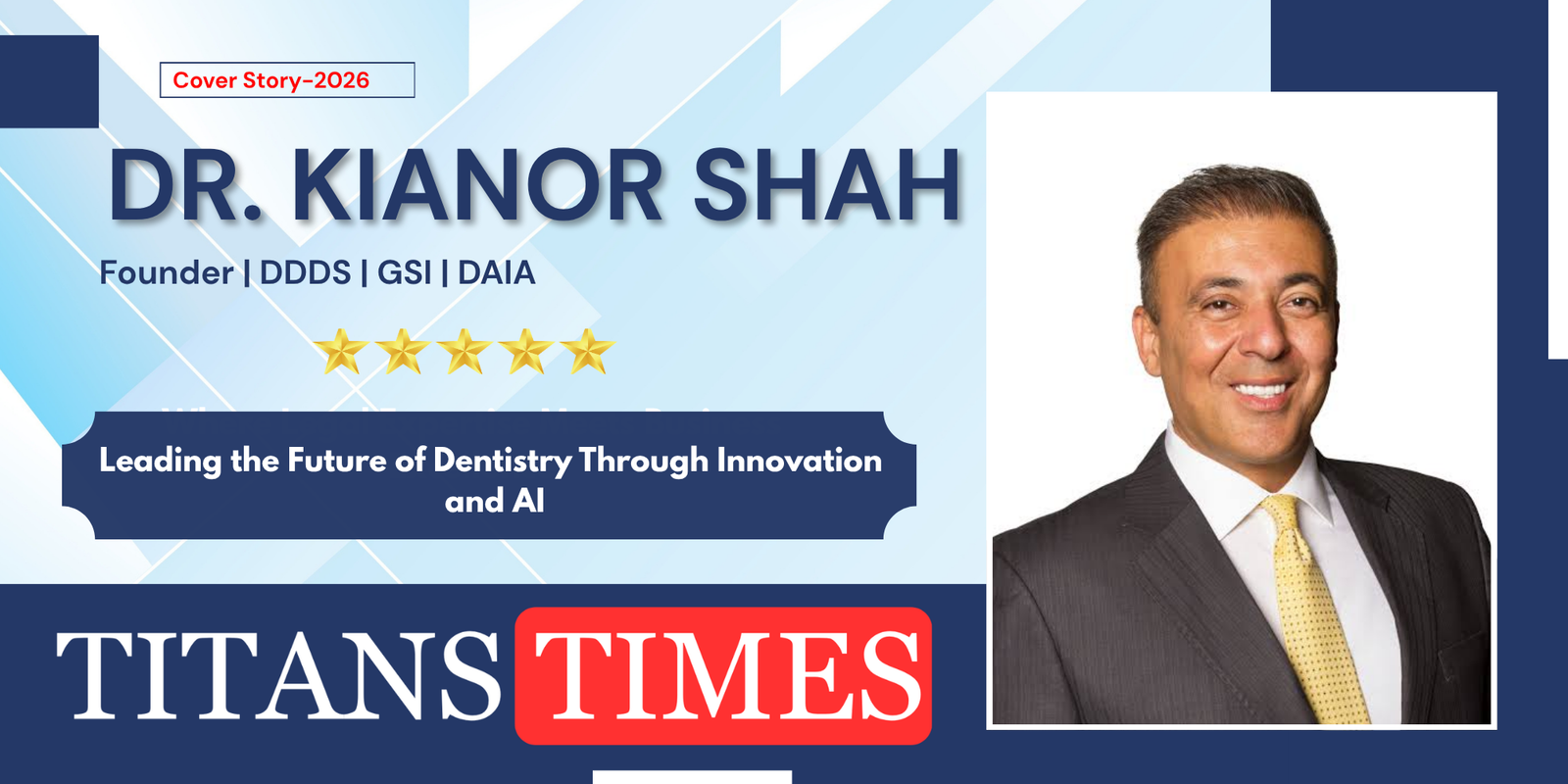
In this context, Dr. Kianor Shah has been featured in the cover story of the 2026 Titans Times Magazine “Leading the Future of Dentistry Through Innovation and AI.”
As a representative of the magazine cover, Dr. Shah embodies a larger discussion on the changing dynamics of dental entrepreneurship, professional association, and advances in technology.
His feature is an occasion to explore how dentistry can keep innovation while not losing sight of the human worth which is still so important in helping to deliver good health care.
With the ever increasing sophistication of technology, the future of dentistry will depend on not only what new systems can do but how properly they can be used, integrated and implemented into the day-to-day clinical environment.
Dr. Kianor Shah and the Changing Landscape of Dental Leadership
There has been significant expansion of roles of dental leaders over the past years.
Clinical success is still vital, but the healthcare system today needs its leaders to be knowledgeable about business processes, patients’ demands, professional education, and innovations.
Many dental specialists have to work in a field where clinical decisions and other issues are related to information systems, management, and new economic factors.
Such a situation creates many opportunities for leadership in the field where various skills are involved.
The connection between the work of clinicians and entrepreneurs should be mentioned specifically.
Leaders who run practices need to combine treatment of patients with managing their staff and technologies, handling financial issues, and other matters.
People who work with professional associations or innovation projects can face various difficulties connected with cooperation and development of strategies.
Presentation of Dr. Shah as the founder of several initiatives featured on the cover page of the Titans Times can be considered in this context.
The main issue is how innovations and professional cooperation can help in creating efficient healthcare system.
Featured Leader Profile
| Profile | Details |
| Featured personality | Dr. Kianor Shah |
| Professional field | Dentistry and healthcare innovation |
| Founder affiliations shown on cover | DDDS, GSI, DAIA |
| Editorial focus | Dental innovation and artificial intelligence |
| Magazine | Titans Times |
| Cover story | Leading the Future of Dentistry Through Innovation and AI |
| Edition | 2026 |
Artificial Intelligence: A New Chapter in Dental Healthcare
Artificial intelligence is becoming an increasingly important subject across healthcare, and dentistry is no exception.
AI-assisted systems are being developed to support image analysis, clinical documentation, treatment planning, administrative workflows, and patient communication.
These technologies have the potential to help professionals recognize patterns, organize information, and work more efficiently.
For example, AI-assisted dental imaging tools may help clinicians identify areas that warrant closer examination.
Digital systems may also support appointment scheduling, record organization, and communication between practices and patients.
However, technological capability should not be confused with independent clinical judgment.
AI-generated findings can be incomplete or incorrect, and their usefulness depends on the quality of the underlying data, appropriate validation, and professional oversight.
Dental professionals must remain responsible for interpreting clinical information within the context of an individual patient’s health, history, and needs.
The goal should be to support better-informed decisions rather than replace the expertise and accountability of qualified practitioners.
This distinction is essential to responsible healthcare innovation.
Why Human-Centered Dentistry Still Matters
Many patients have doubts about going to the dentist.
Some are concerned about discomfort or treatment costs. Others might have had bad experiences in the past or may not be well-versed in the procedures being recommended.
Technology can assist in the understanding of clinical findings but is no substitute for empathy.
The patient-centered approach starts with listening.
The dentist should know what the patient is feeling, and discuss the options with them and offer them information on the benefits, limitations, and risks.
Informed consent and open communication are crucial in the provision of ethical care.
Digital applications can help in this process, as they can make images easier to understand or can help in visualizing treatment options.
However these tools are best when used in the context of a meaningful conversation.
So the future in dentistry should not only be judged by the advancement of the technology, but also by the quality of the patient experience.
When innovation supports people to feel informed, respected and supported throughout their care, it makes sense.
The Role of Entrepreneurship in Dental Innovation
Entrepreneurship has long influenced the development of healthcare services.
New practices, technologies, educational platforms, and professional organizations often begin when individuals recognize opportunities to address existing challenges.
In dentistry, entrepreneurial thinking can contribute to improved workflows, new service models, stronger professional networks, and broader access to information.
However, healthcare entrepreneurship differs from many other business activities because patient safety and professional responsibility must remain central.
Commercial success cannot be the only measure of value.
A promising solution must also be evaluated for clinical relevance, reliability, affordability, and its effect on patients and practitioners.
Entrepreneurs working in dental healthcare must consider whether their innovations solve genuine problems.
Does a new system reduce unnecessary administrative work? Does it improve the quality of available information? Can dental teams adopt it without creating unreasonable complexity?
These practical questions help distinguish meaningful progress from technological novelty.
Key Areas Shaping the Future of Dentistry
| Innovation area | Potential contribution | Important consideration |
| AI-assisted imaging | Supports review of dental images | Requires clinical validation and oversight |
| Digital treatment planning | Helps organize and communicate treatment options | Plans must be individualized |
| 3D scanning and printing | Supports selected restorative and orthodontic workflows | Accuracy and suitability vary by application |
| Practice automation | Reduces repetitive administrative tasks | Data security and reliability |
| Teledentistry | Supports certain consultations and follow-ups | Not a substitute for every in-person examination |
| Digital patient education | Makes clinical information more accessible | Information must be accurate and understandable |
Building Stronger Connections Across the Dental Community
Healthcare innovation rarely develops through isolated effort.
It often requires collaboration among clinicians, researchers, educators, engineers, technology developers, and business professionals.
Each group brings a different perspective.
Clinicians understand the practical challenges of patient care. Researchers investigate new approaches and evaluate evidence. Technology specialists develop systems capable of supporting specific workflows.
Educators help professionals understand how emerging knowledge can be applied responsibly.
When these perspectives come together, innovation can become more relevant to real clinical needs.
Professional networks and educational initiatives can also help practitioners share experiences, discuss challenges, and learn from one another.
This exchange is especially important when new technologies are introduced.
A tool that performs well in a controlled environment may encounter unexpected difficulties in everyday practice.
Feedback from dental professionals can help identify those limitations and support further improvement.
Collaborative leadership therefore has an important role in connecting innovation with practical experience.

Making Advanced Dental Technology More Accessible
One of the most important questions surrounding healthcare innovation is who will benefit from it.
Advanced technologies can create opportunities for improved efficiency and clinical support, but they may also introduce financial and operational barriers.
Dental practices vary considerably in size, location, patient population, and available resources.
A large organization may have the capacity to invest in sophisticated digital systems, while a smaller independent practice may face greater financial constraints.
Technology developers and healthcare leaders must therefore consider accessibility alongside capability.
Solutions that are difficult to implement, maintain, or understand may struggle to achieve broad adoption.
Training is another important factor.
Dental professionals need appropriate education to evaluate the strengths and limitations of emerging tools.
Without sufficient training, even a technically sophisticated system may fail to deliver its intended benefits.
A more inclusive approach to innovation considers affordability, usability, support, and long-term sustainability.
Ethical AI and the Responsibility of Dental Leaders
Artificial intelligence introduces important ethical considerations in healthcare.
Patient information is sensitive, and digital systems must be designed and operated with appropriate safeguards.
Dental organizations adopting AI-enabled tools need to consider data privacy, cybersecurity, accuracy, accountability, and applicable regulatory requirements.
Transparency also matters.
Professionals should understand the purpose and limitations of the tools they use, particularly when those tools influence clinical decisions.
AI systems may perform differently across patient populations or clinical settings.
This makes ongoing evaluation important.
Responsible implementation requires more than purchasing software. It involves establishing appropriate procedures, training users, reviewing performance, and ensuring that qualified professionals remain accountable for patient care.
These responsibilities illustrate why ethical judgment will remain an essential leadership capability in an increasingly digital healthcare environment.
Developing the Next Generation of Dental Professionals
The future of dentistry will be shaped by professionals who combine clinical expertise with adaptability and technological understanding.
Dental education must continue providing strong foundations in anatomy, diagnosis, treatment, patient communication, and professional ethics.
At the same time, emerging technologies are creating new learning requirements.
Future practitioners may need greater familiarity with digital imaging, data interpretation, AI-assisted workflows, and technology evaluation.
Continuous professional development will therefore become increasingly important.
Experienced clinicians can contribute practical wisdom developed through years of patient care, while younger professionals may bring familiarity with emerging digital tools.
Collaboration between generations can strengthen the profession.
Mentorship remains especially valuable because technical competence alone does not prepare someone for every challenge of clinical practice.
Professional judgment, empathy, communication, and responsible decision-making develop through experience, reflection, and constructive guidance.
Balancing Innovation with Professional Independence
As healthcare technology becomes more integrated into clinical operations, dental professionals must carefully consider how external systems influence their work.
Digital platforms can improve efficiency, but they should support rather than undermine professional judgment.
Clinicians need to understand the assumptions and limitations of the tools they use.
They must also remain capable of questioning recommendations that do not align with a patient’s circumstances.
Professional independence is closely connected to accountability.
A technology provider may develop a sophisticated system, but clinical decisions still require appropriate evaluation by qualified practitioners.
Maintaining this distinction helps protect the relationship between healthcare professionals and patients.
It also reinforces the principle that innovation should serve the goals of healthcare rather than dictate them.
The Future of Dentistry: Opportunities and Responsibilities
The next decade is likely to bring continued development in digital dentistry, AI-assisted workflows, materials science, and patient communication.
Some innovations may improve administrative efficiency. Others may support more precise planning or introduce new ways of delivering services.
However, progress will not be uniform.
Different technologies will mature at different rates, and their clinical value will depend on evidence, appropriate implementation, and real-world outcomes.
Dental leaders will need to distinguish between promising possibilities and established capabilities.
They will also need to consider the long-term implications of technology investments.
A successful innovation strategy should connect technical progress with patient needs, workforce development, operational sustainability, and professional responsibility.
The most effective organizations will be those that remain open to change without abandoning the principles that make healthcare trustworthy.
Traditional Priorities and Emerging Opportunities in Dentistry
| Leadership dimension | Established priority | Emerging opportunity |
| Clinical care | Accurate assessment and treatment | Validated digital decision-support tools |
| Patient experience | Trust and communication | More accessible digital information |
| Practice management | Reliable daily operations | Responsible workflow automation |
| Professional education | Clinical skills and experience | Continuous digital and AI literacy |
| Collaboration | Professional referrals and networks | Interdisciplinary innovation |
| Ethical responsibility | Patient safety and confidentiality | AI governance and data accountability |
Looking Ahead: A More Connected Dental Future
The transformation of dentistry is not simply a technological story.
It is also a story about people, professional relationships, and the willingness to improve how care is delivered.
AI and digital systems may help dental professionals manage information and improve selected processes, but lasting progress requires thoughtful implementation.
Patients must remain at the center of decision-making.
Practitioners need access to reliable evidence and appropriate training.
Organizations must balance innovation with ethical and operational responsibilities.
And leaders must recognize that meaningful change often requires collaboration across different professional disciplines.
The strongest future for dentistry will emerge when technological capability and human expertise reinforce one another.
Dr. Kianor Shah: A Cover Story About the Future of Dental Innovation
With the theme “Leading the Future of Dentistry Through Innovation and AI,” the cover story in Titans Times Magazine highlights some of the most critical questions of the modern dental healthcare setting that Dr. Kianor Shah addresses.
What are the ways in which technology can enhance clinical workflows while not compromising clinical judgment?
What are the ways that dental professionals can adopt innovation, while also building patient trust?
But how do entrepreneurship, learning and collaboration help pave the way to a more accessible and sustainable future?
These questions are not specific to any one organization or technology.
They involve the direction of a whole profession.
The future of dentistry will not be seen as being just a matter of what tools are used, but rather how those tools are used.
Innovation creates possibilities. Those possibilities are realized as meaningful progress through leadership.
The dental profession’s biggest opportunity is to unite these two; to create a future that allows technology to augment clinical care, foster professional partnerships and lead to improved patient experiences.