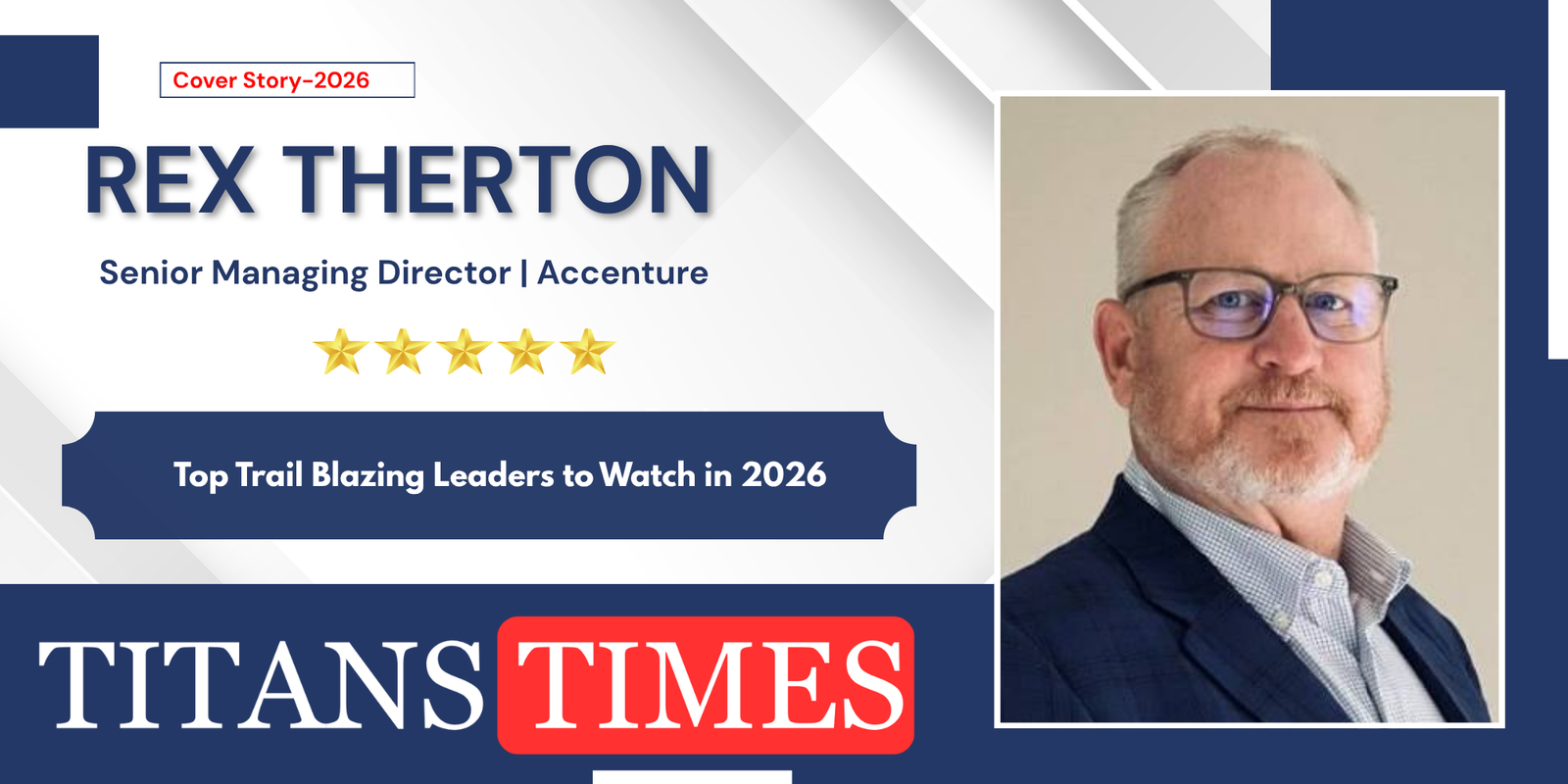
Rex Therton
Senior Managing Director | Accenture
Top Trail Blazing Leaders to Watch in 2026
Exploring the leadership principles, strategic thinking, and human-centered values shaping the next generation of business transformation.
Leadership Beyond Titles: The Power of Vision and Purpose
Leadership is not a job that is reserved for anyone in any organization anymore, whether it is a small or a large organization; it is no longer about the authority; it is no longer about the corporate position; it is about the person who has the passion and drive to lead the people. It is being evaluated more and more on how well one can inspire, lead through uncertainty, inspire innovation and make impactful progress in a world where change is the norm.
Industries and organisations are looking at new approaches to their business model, new technologies to utilize, and a new way to meet the growing expectations of customers, employees and stakeholders. Such developments require leaders to be capable of seeing past the problems of the short term and foresee the possibilities for long-term change.
Among the executives highlighted in Titans Times Magazine’s special edition, “Top Trail Blazing Leaders to Watch in 2026,” is Rex Therton, Senior Managing Director at Accenture.
His role puts him in a unique position that allows him to be a part of the global professional services landscape where technology, strategy, innovation and business transformation converge.
The need to align digital progress with human capacity has become more critical than ever for organizations that are looking for ways to find a balance between them.Senior leadership is especially critical in helping organizations align digital progress with human capacity. Successful transformation is more than just rolling out new systems. Requires strategic clarity, organizational alignment, effective communication and understanding of the impact of change on people.
Rex’s participation in this edition is a chance to examine the attributes of effective leadership in a global economy in a different era.
Navigating a New Era of Business Transformation
The modern business environment presents a combination of opportunities and challenges that previous generations of leaders could scarcely have imagined.
Artificial intelligence, automation, cloud technologies, advanced analytics, and digital platforms are transforming how organizations operate and compete.
At the same time, businesses face increasing pressure to improve operational efficiency, strengthen resilience, attract skilled professionals, and deliver meaningful value to customers.
For senior executives, the challenge is not simply to keep pace with technological developments but to understand how these developments connect with broader business objectives.
As a Senior Managing Director at Accenture, Rex holds a leadership designation within an organization recognized for its work in consulting, technology, and business transformation.
Such an environment underscores the importance of connecting strategic priorities with execution.
A successful transformation initiative must begin with a clear understanding of the organization’s needs. Technology can support progress, but lasting results depend on how effectively businesses align processes, capabilities, and people.
This broader perspective is particularly relevant in 2026, as organizations continue examining how emerging technologies can improve decision-making, customer experiences, and long-term competitiveness.
The Human Side of Effective Leadership
Behind every successful business strategy are people responsible for bringing it to life.
Organizations may invest in sophisticated technologies, innovative platforms, and ambitious growth initiatives, but their ability to deliver results ultimately depends on the commitment, adaptability, and collaboration of their teams.
This makes human-centered leadership increasingly important.
Effective executives must create environments where employees understand organizational priorities, feel encouraged to contribute ideas, and have the support necessary to adapt to change.
Communication is central to this process.
When leaders explain not only what an organization intends to achieve but also why those objectives matter, teams are better positioned to connect their individual responsibilities with a shared purpose.
Equally important is the ability to listen.
Employees working directly with customers, operational processes, and emerging technologies often possess insights that can improve strategic decisions.
Leaders who encourage constructive dialogue can create stronger connections between organizational vision and everyday execution.
For senior professionals operating in complex global business environments, balancing strategic direction with employee engagement remains a defining leadership challenge.
Innovation with Intention: Turning Technology into Business Value
Innovation has become one of the most frequently discussed priorities in the corporate world. Yet meaningful innovation requires more than adopting the latest technological developments.
The real challenge lies in identifying where new capabilities can solve existing problems, improve customer experiences, strengthen operations, or create opportunities for sustainable growth.
Artificial intelligence provides a compelling example.
Businesses across industries are exploring how AI can support data analysis, automate repetitive processes, improve service delivery, and assist employees with increasingly complex tasks.
However, successful adoption requires careful consideration of organizational readiness, governance, workforce capabilities, and measurable business outcomes.
Technology investments must be supported by thoughtful implementation strategies.
Without clear objectives and appropriate oversight, even promising innovations may fail to deliver their intended value.
The growing importance of responsible technology adoption highlights the need for executives who can evaluate both opportunity and risk.
For organizations navigating digital transformation, the most effective approach is often one that combines technological ambition with practical execution and an understanding of human needs.
Strategic Thinking in an Uncertain Global Economy
One of the most demanding responsibilities of modern leadership is making decisions in an environment where circumstances can change quickly.
Economic uncertainty, technological disruption, shifting customer expectations, and evolving competitive pressures can challenge even well-established business strategies.
In such conditions, effective leadership requires a balance between confidence and adaptability.
Long-term objectives provide direction, but organizations must remain willing to reassess their methods when new information emerges.
Strategic thinking therefore involves identifying priorities, understanding potential risks, evaluating available resources, and maintaining flexibility.
It also requires distinguishing between short-term activity and meaningful progress.
Not every emerging trend warrants immediate investment. Not every operational challenge requires a complete organizational redesign.
Successful leaders must determine which initiatives offer genuine value and which may distract from more important objectives.
For executives working within large and complex organizations, these decisions frequently involve balancing innovation with stability, growth with efficiency, and ambition with accountability.
Building a Culture of Collaboration and Accountability
Sustainable organizational performance depends on more than individual leadership capability.
It requires systems and cultures that encourage people to work toward common objectives while remaining accountable for their responsibilities.
Collaboration becomes especially important when organizations operate across different functions, markets, and geographical regions.
Teams may bring different perspectives, technical capabilities, and professional experiences to the same challenge.
Effective leadership helps connect those perspectives rather than allowing organizational boundaries to limit progress.
A collaborative culture also benefits from clearly defined expectations.
When employees understand their responsibilities, decision-making authority, and performance objectives, they can contribute more confidently.
Accountability should not be viewed exclusively as a mechanism for evaluating outcomes. It can also create opportunities for learning, improvement, and stronger execution.
Organizations that combine collaboration with responsibility are often better positioned to respond to change and maintain progress during uncertain periods.

Developing Future-Ready Leaders
As technology and business expectations evolve, leadership development is becoming a strategic priority for organizations around the world.
Future leaders will need more than technical knowledge or traditional management experience.
They will require adaptability, emotional intelligence, communication skills, ethical judgment, and the ability to work across disciplines.
Continuous learning will be essential.
The rapid evolution of artificial intelligence and digital technologies means that professional knowledge can become outdated more quickly than in previous decades.
Organizations must therefore encourage employees and managers to develop new capabilities throughout their careers.
Mentorship also remains valuable.
Experienced professionals can help emerging leaders understand how to navigate difficult decisions, manage stakeholder expectations, and approach challenges with perspective.
At the same time, younger professionals can introduce fresh thinking and familiarity with new technologies.
The exchange of knowledge between generations can strengthen organizational capability and encourage innovation.
In this context, senior leadership has an important role in creating opportunities for professional growth and preparing teams for responsibilities that may not yet exist.
Balancing Business Performance with Long-Term Responsibility
In today’s organizations, social implications of decisions are becoming increasingly important.
While financial performance still plays a key role, businesses need to consider the impact of their strategies on employees, customers, communities and other stakeholders.
The ability to assume a broader sense of responsibility is a growing facet of current leadership discourse.
Trust, accountability and making decisions in a way that helps build organizational resilience are key to long-term business success.
Embracing new technologies is also a part of responsible leadership.
With the integration of AI-powered systems and automated processes in businesses, data protection, transparency, fairness, and oversight emerge as relevant questions.
Companies that think about such things early on can prepare themselves to keep stakeholder trust as they grow in technological capabilities.
The issue for business leaders is to build responsibility into strategy, not make it a stand-alone agenda for an organization.
Looking Ahead: The Leadership Qualities That Will Define 2026 and Beyond
The coming years will continue to test the ability of organizations to adapt, innovate, and respond to changing expectations.
Artificial intelligence is likely to remain a major influence on business transformation, while cybersecurity, workforce development, operational resilience, and digital trust will continue to shape executive priorities.
Against this backdrop, the qualities associated with effective leadership are also evolving.
Strategic vision must be supported by execution.
Technological understanding must be accompanied by human judgment.
Innovation must be connected to measurable business value.
And organizational ambition must remain balanced with responsibility.
The leaders who navigate these demands successfully will be those capable of connecting long-term direction with practical action.
They will understand that transformation is not a single project or technological investment, but an ongoing process of learning, adaptation, and improvement.
A Perspective on Trailblazing Leadership
Trailblazing leadership isn’t just about being the first to adopt a new idea.
It is the ability to identify significant opportunities, make considered choices and assist organisations to progress with direction.
Senior Managing Director Rex Therton of Accenture is highlighted in the Top Trail Blazing Leaders to Watch in 2026 section of Titans Times Magazine, and as such, his post is a good starting point for considering the requirements of leadership in today’s world of business transformation.
People and organisations who can bring innovation plus responsibility, strategy plus execution, technology plus empathy will define the future of business.
Finally, a meaningful leader is one who decides not just what to do in a specific moment in time, but what to create for the future of their organization — the skills, connections, and opportunities it will offer.